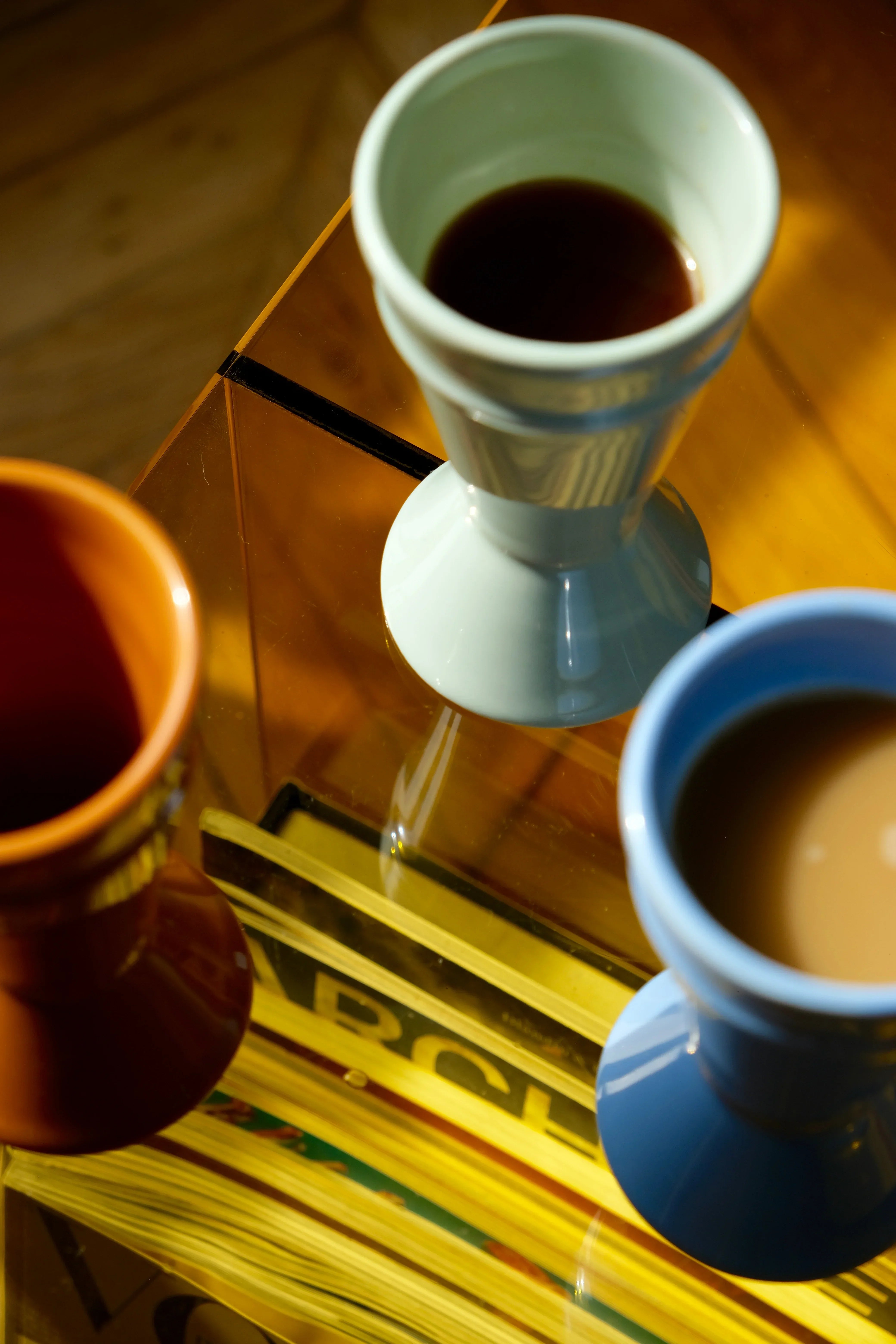
An object steeped in history
Before it was a cup, the mazagran was… a drink. Its name comes from a village in Algeria, Mazagran, where French soldiers reportedly drank cold coffee during the 1840 battle. This particular beverage—coffee diluted with water or brandy—then supposedly gave its name to the container that held it: a tall, footed glass without a handle.
This new type of cup quickly charmed Parisian cafés. The mazagran became a symbol of conviviality and modernity, long before the arrival of the mug. Made of earthenware, porcelain, or stoneware, it graced bistro tables and family homes.
The mazagran, a witness to French daily life
In many families, the mazagran evokes a memory; at Atelier Maison Quatre, this memory holds particular significance.
"As a child, I spent my Sundays with family in Normandy. After lunch, my grandmother, Joséphine, would bring out her set of floral mazagrans for coffee. This simple, almost immutable ritual left a lasting impression on me."
— Juliette, founder of Atelier Maison Quatre
These moments of sharing, where the act of drinking coffee brings people together, became the starting point for a project: reinventing the mazagran so it could reclaim its place in today's homes.
Reinventing an icon: the Atelier Maison Quatre vision
Atelier Maison Quatre breathes new life into this everyday heritage object by giving it a contemporary interpretation. Gone are the floral patterns: instead, sobriety, raw material, and timeless form take center stage.
Each ceramic mazagran is crafted in Portugal, in a partner workshop where artisanal know-how is preserved. The stoneware, chosen for its strength and natural texture, is hand-enameled, making each piece unique.
The design respects the cup's original proportions—13.5 cm height, slender shape, stable foot—while adopting purer lines and colors inspired by nature. Six colors make up the first collection: neutral and organic tones that suit any table setting.
An object for all occasions
The mazagran from Atelier Maison Quatre adapts to new uses:
-
Morning coffee, served hot.
-
Long coffee or afternoon tea.
-
Cool drinks in summer, echoing its origins.
-
Or simply, a beautiful object to display, a testament to a way of life.
More than a cup, the mazagran has become a daily companion, an object to keep, to pass on, that transcends seasons and generations.
Reasoned and European production
True to its values, Atelier Maison Quatre favors responsible production:
-
European manufacturing, in a human-scale workshop.
-
Durable and recyclable materials.
-
Packaging designed in France, intended to protect without excess.
Every detail reflects a belief: it is possible to create beauty, quality, and durability.
Between memory and design
Reinventing the mazagran means paying homage to a forgotten ritual while rooting it in our current era. It's about blending history and modernity, ancient gestures and contemporary lines, childhood memories and today's design.
At Atelier Maison Quatre, this project is not just about an object:
it's a way of bringing meaning back to simple moments, of celebrating slowness and conviviality—through a cup.
About Atelier Maison Quatre
Atelier Maison Quatre is a French brand founded in 2024, dedicated to tableware and contemporary ceramics. Born from childhood memories and a deep appreciation for simplicity, it celebrates everyday objects by reinventing them with sincerity, exacting standards, and emotion.
Mentioned multiple times in the press—notably in Le Monde, ELLE Décoration and Le Journal de la Maison—the brand gained recognition with its first product, the mazagran: an object from yesterday, crafted for today.
FAQ: The History and Modernity of the Mazagran
Where does the mazagran come from? What is its history?
The mazagran takes its name from the Algerian village of Mazagran, where French soldiers reportedly drank cold coffee during the 1840 battle. Upon their return to France, this diluted coffee beverage became popular, and its name shifted from the drink to the container: a tall, footed glass without a handle.
Why did the mazagran disappear and then reappear?
The mazagran was eclipsed by the arrival of espresso machines and the popularization of the mug in the 20th century. It is now making a comeback, driven by renewed interest in objects rich in history, European craftsmanship, and slow coffee culture.
Where are Atelier Maison Quatre mazagrans made?
Atelier Maison Quatre mazagrans are made in Portugal, in a partner artisanal workshop. Each piece is hand-enameled stoneware, which makes every mazagran subtly unique.
Is the mazagran a collector's item?
Yes. Many collectors seek antique mazagrans in porcelain or earthenware, decorated with floral patterns dating from the 19th and 20th centuries. The New Mazagran from Atelier Maison Quatre is a contemporary version designed for daily use while retaining this heritage dimension.
Is the mazagran suitable for restaurants and hotels?
Yes. Its distinctive shape and history make it an ideal choice for hotel, restaurant, and café tables wishing to offer a unique coffee experience. Atelier Maison Quatre offers professional orders for establishments.


